To celebrate the May 5th launch of Follow the Moon and Stars here's a new series on #NottsWriters:
 |
| James Prior (1851–1922) |
It was on Mapperley Road near the centre of Nottingham that
Prior was born. By the age of twenty-seven he had little to show for his
literary efforts so he took a teaching position at a boarding school.
After his father died, he became involved with his uncle in
a farming business but the money dried up. As it turned out, this would not be
a wasted five years, as the experience would inform Prior’s novel Forest Folk
(1901). By this time Prior was fifty years old.
After marrying his cousin Lily Kirk, Prior returned to
Nottingham, living in Radcliffe-on-Trent before heading to Bingham, and it was
here that all of his best work was written. He lived in Bingham from 1891 to
1922, first at 19 Fisher Lane, a home called Lushai Cottage (previously named
Brusty Cottage), then at the neighbouring Banks, at Banks Cottage.
Prior would go for a ramble and bring home a quaint saying or
even a new chapter, though much of his time in Bingham was spent as a social
recluse.
James Prior has been called the ‘Thomas Hardy of
Nottinghamshire’ and comparisons can even be made to DH Lawrence, who shared a
publisher with Prior and rated, if pitied, the author. Lawrence wrote, ‘What a
curious man James Prior is!’ and wondered why Prior was a ‘failure.’
His first published novel, Renie, was followed in 1897 by
Ripple and Flood.
Ripple and Flood, is a story of his beloved river, the “smug
and silver Trent”.
‘My prime consolation was neither book nor friend, but what
entered my eye. What has once entered thereby remains, I am convinced, locked
in my memory but the key hangs out of my reach.’
Then came Forest Folk, set during an eventful period of
history that covers the Napoleonic Wars and Luddite riots. It’s about the
farming community near Sherwood Forest.
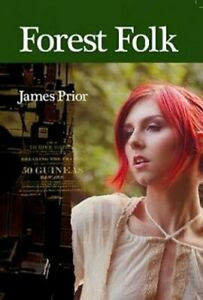
Forest Folk was republished in 2017 by Nottingham’s Spokesman
Books.
The all-important follow-up to this success was the
disappointing Hyssop.
Arguably his best book, A Walking Gentleman, arrived
three years later. It’s the story of a gentleman who decamped on the eve of his
wedding, making escape from the “madding crowd” and encountering many strange
adventures on the way.
“Do yer want to faight or don’t yer?”
“I leave the choice to you.”
“Damn yer mealy mouth! Do yer or don’t yer?”
“Well, I don’t.”
“Then I’ll faight yer for not wantin’.”
From A Walking Gentemen
Prior’s last published work was Fortuna Chance (1910), set in the
1720s.
The author was granted a small pension in recognition of his services to
literature.
Writing of Fortuna Chance, the great John Buchan
said,
“I do not think there is such a master of the English countryside. His
peasants seem to me quite as good as Mr Hardy’s and he has the astonishing power
of producing impressions of scene and weather. Further he is a true artist in
the construction of his stories and they provide moments of finer drama than
almost any modern novelist.”
Don Pedro the Cruel was his other published work. He left
unpublished manuscripts, November, Loose-Strife and Ware Aegir (a play).
His collected poetry did make a slim volume, published in 1925,
and Bromley House Library has a copy. The collection includes two beautifully
tender poems written when his wife Lily died.
Prior himself died in his small Bingham cottage in 1922. He was
buried in Bingham’s cemetery. His headstone reads:
In loving memory of James Prior Kirk better known as James
Prior
Died Dec 19th 1922 aged 71
Also his wife Lily, died Mar 9th 1914 aged 48
Also of their sons, Walter, died of wounds in France,
Aug 17th 1918 aged 26,
and Harold, died Apr 25th 1931 aged 23