It’s natural that Nottingham
is bidding for UNESCO City of Literature status given that our literary
history is so remarkable. Below is my A-Z guide
of Notts-Lit. With many of the letters I was spoilt for choice (so there are
some notable omissions), other letters were difficult to fill - X anyone? (Xylophone
Man, our famous busker with his plaque on Lister Gate, nearly made the cut).
Alan Sillitoe is
best known for his first two works: the novel Saturday Night and Sunday Morning
and the short story collection The Loneliness of the Long Distance Runner.
Sillitoe was born in Nottingham and drew on his experiences living in the city
when writing his gritty depictions of working-class British life in the
post-war era.
 |
Albert Finney portrayed the 'Angry Young Man' Arthur Seaton in the 1960 film version of
Saturday Night and Sunday Morning |
Bromley House Library,
founded in 1816, is one of the few remaining subscription libraries in the
country. The fine Grade II* listed Georgian townhouse keeps 40,000 books and is
situated in the centre of Nottingham. On the first-floor is a Meridian Line,
dating from 1836, which was used to set clocks to Noon local time in the days
before Railway time or Greenwich Mean Time.
Charlie Resnick is
the jazz-loving Nottingham DI and protagonist of John Harvey’s twelve police
procedurals set in the city. The first and final novels in the series (Lonely
Hearts and Darkness, Darkness respectively) are particularly good.
 |
| Academy award nominee Tom Wilkinson played Resnick in the BBC films based on Harvey's novels Lonely Hearts and Rough Treatment |
D H Lawrence is
one the 20th century’s greatest writers and poets. Eastwood born
Lawrence penned such classics as Lady Chatterley’s Lover, Sons and Lovers,
Women in Love and The Rainbow. The fourth child of a struggling coal miner, he
won a scholarship to Nottingham High School and later studied at Nottingham
University.
 |
| A bust of Bertie at Nottingham Castle |
Edward Harley was
a dedicated and extravagant collector adding to a library started by his wealthy
father. Edward’s collection included pivotal works such as Shakespeare’s second
folio and Jonathan Swift’s Gulliver’s Travels. By the end of his life in 1741
he had amassed the largest private library in Britain containing 50,000 printed
books, a collection that helped found the British Library.
 |
| Edward Harley, 2nd Earl of Oxford and Earl Mortimer |
Festus, the
longest poem in the English language, was written by Nottingham’s Philip James
Bailey. Born in 1816, Bailey was brought up on the poetry of Lord Byron. Festus
is a vast pageant of theology and philosophy, comprising in some twelve
divisions an attempt to represent the relation of God to man and of man to God.
Tennyson was among the poem’s admirers.
“We live in deeds not years In thoughts not breaths In
feelings not figures on a dial. We should count time by heart throbs. He most
lives who thinks most, feels noblest, acts the best.” From Festus.
 |
| Philip Bailey in his study at the Rope Walk |
Graham Greene
lived in Nottingham in the mid-1920s while he worked as a sub editor on the
Nottingham Journal. His novel A Gun For Sale was set in a fictional version of Nottingham
and his time living in the city helped inspire Brighton Rock. He left
Nottingham after being baptized in the Roman Catholic faith.
 |
| The Express Offices. 'I have happy memories of this bizarre old building...' Graham Greene |
Helen Cresswell was
one of Britain's most prolific children's writers. The Nottinghamshire author -
educated at Nottingham Girls High School - of many critically acclaimed novels
also wrote for TV and received a BAFTA Writers’ Award. Her writing credits
include Lizzie Dripping and Moondial.
 |
| Set at Belton House near Newark |
International Impac
Dublin Literary Award winner Jon McGregor wrote his first book, the multiple award winning and Booker nominated
If Nobody Speaks of Remarkable Things, after moving to Nottingham where he
still lives. He won the IMPAC award, one the world's most lucrative literary prizes, for
his third novel Even the Dogs.
 |
| Jon McGregor with his IMPAC award |
J R R Tolkien repeatedly
visited Nottingham, staying at his Aunt Jane's farm. He wrote the first draft
of The Voyage of Earendel the Evening Star there describing it as "a
tremendous opening up of everything for me" and the start of his mythology.
It’s believed that he based the wizard Gandalf on his aunt who had strong
physical presence and mystical tendencies.
 |
For more on Tolkien's Gedling read Andrew H Morton and John Hayes' book
|
Katharine (also known
as Mollie) Morris was nine years old when her first story was published in
Tiger Tim’s Weekly. A publisher later advised her to write about the village in
which she lived. That place was Bleasby in Nottinghamshire and it provided
Katharine with the material for five novels including The Long Meadow.
 |
| Her 1958 novel |
Lord George Gordon
Byron was a poet, adventurer and a leading figure in the Romantic Movement.
Whilst living in Southwell he wrote his first poem, aged ten:
In Nottingham county
there lives at Swine Green,
As curst an old lady as ever was seen;
And when she does die, which I hope will be
soon,
She firmly believes she will go the moon.
Byron was buried in Hucknall, Notts, and the county is home
to his ancestral home, Newstead Abbey.
 |
| Tribute to Byron at St. Mary Magdelene Church, Hucknall |
Mhairi McFarlane
lives in Nottingham and is a former reporter-turned-feature writer on the
Nottingham Post. The bestselling chick-lit author is one of Britain’s best and
funniest rom-com writers. Nottingham's award-winning production company
Wellington Films are working on a movie version of her debut novel You Had Me
At Hello.
 |
| Mhairi McFarlane's 2nd novel |
Nigel McCrery lives
in Nottingham, the city he served as a police officer working on a number of
murders and serious crimes. He later became the creator of many successful
television shows including Silent Witness and New Tricks. The author of several
fine novels, Nigel has also penned non-fiction titles on forensic science, the
Second World War and the 1980 Iranian Embassy siege.
 |
| George Spencer Academy in Stapleford named their Learning and Inclusion Centre after former pupil Nigel McCrery. |
Odyssey came from
the pen of a young, headstrong, unmarried Sicilian woman, according to Samuel
Butler, whose easy-read translation of Odyssey in 1900 was hugely popular. The
Victorian novelist, philosopher, satirist, artist and critic often challenged the
accepted views of religion, evolution, art and literature. A proud son of
Notts, he was much admired by George Bernard Shaw and E M Forster, and
influenced Aldous Huxley's seminal Brave New World.
 |
| St Andrew's Church, Langar, where Samuel Butler's father was rector |
Peter Pan creator
J M Barrie lived in Nottingham in the mid-1880s working as a writer at the
Nottingham Daily Journal. It’s said
that he took the character of Peter Pan from a little boy he saw walking
alongside the River Trent, and Nottingham’s Arboretum is claimed to have inspired
the setting of Neverland.
 |
| Barrie explored the Arboretum's beautiful park in his spare time |
Quaker poet and
prolific children’s author Mary Howitt introduced British readers to the
stories of Hans Christian Andersen. She learnt Danish specifically in order to
translate Andersen’s tales and, at one time, they were friends. Mary lived in Nottingham
with her author husband William and is perhaps best-known for the 1829 poem The
Spider and The Fly.
 |
| Thumbelina was one of Andersen’s stories first translated by Mary Howitt |
Robert Harris was
born in Nottingham in 1957 and grew up on a council estate where he enjoyed a culturally
rich childhood. The son of a Nottingham printer became a worldwide bestselling
novelist with classics Fatherland, The Ghost, Enigma, An Officer and a Spy and
others, several of which have been made into films.
 |
| Alternative history most chilling |
Stanley Middleton
won the Booker Prize in 1974 for his book Holiday, one of his 44 novels, many
set in ‘Beechnall’ (his home city of Nottingham). Born in Bulwell, he attended High
Pavement School, took a teaching diploma at University College Nottingham and
taught English at a Nottingham school for many years. His work explored the quiet
everyday lives of middle-class professional men.
 |
| Stanley Middleton 1919-2009 |
Tales out of School by Geoffrey Trease,
a ground-breaking survey about children’s books, was published in 1949. Geoffrey,
the youngest son of a Nottingham wine merchant, wrote historical fiction for
children, not for any literary merit but because it helped to nurture the
children of Britain. The Nottingham born writer produced 110 books in a 60 year
career. One of his stories, A Flight of Angels, was inspired by the deep sandstone
cellar-caves dug out under Nottingham by the old wine merchants.
 |
| The sign over this Castle Gate door marks the site of the family business of the innovative children’s author. |
Unfit to Plead is
one of the best of Frank Palmer’s six crime novels featuring DI 'Jacko' Jackson.
The author’s second series followed Nottingham cop Phil ‘Sweeney’ Todd. Before
retiring to write detective fiction Frank was a successful journalist. The
first to interview Matt Busby after the Munich Air disaster, he achieved the
rare feat of writing the day’s front and back page leads for the Daily Express.
 |
In 1978 Frank won the British Press Reporter of the Year award for his scoop on the infamous sex-in-chains case involving Joyce McKinney and the kidnapped Mormon missionary.
|
Victoria Four-Thirty
is one of Cecil Roberts’ most read novels. First published in 1937 and
translated into many languages, it’s about a journey from London’s Victoria Station
through Europe, and the differing experiences thirteen of the travelers have on the train. The
author edited the Nottingham Journal between 1920 and 1925 and was a friend of
Graham Greene.
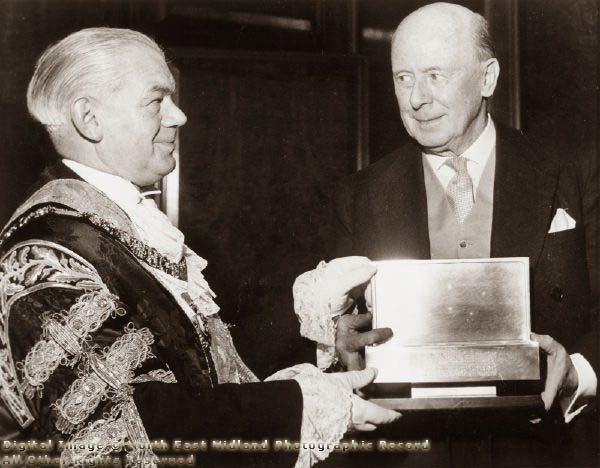 |
Cecil Roberts receiving his Freedom of Nottingham award in 1965
|
William Howitt was
a carpenter’s apprentice in Mansfield when Sherwood Forest inspired his
poetical imagination. Together with
his wife Mary, William wrote 170 books from the time of their marriage
in 1821. On moving to Nottingham they joined the subscription library (at Bromley House on Angel Row). Their
arrival in the city coincided with their first collaborative book, The Forest
Minstrels and Other Poems, published in 1823.
 |
| Sculpture in the portico of Nottingham Castle |
X-ray computer
tomography (CT) was developed by Godfrey Hounsfield. Born and raised on a farm
near Nottingham, his vital work delivered a Nobel Prize in 1979 and is examined
in a book by S. Bates, L. Beckmann, A. Thomas and R. Waltham, entitled Godfrey
Hounsfield: Intuitive Genius of CT. It includes many recollections from
Hounsfield's family, friends and colleagues.
Young Robin Hood by
George Manville Fenn is about a boy that gets lost in Sherwood Forest.
Separated from his father the little lad meets Robin Hood and his merry men. Published
in 1899, with 23 illustrations, this popular children’s story is a good example
of the many hundreds of tales inspired by the legend of Robin Hood and his
association with Notts.
Zoe Sharp, the
award-winning author of the Charlie Fox thriller series, was born in
Nottinghamshire. Her work has been
nominated for the prestigious Edgar, Anthony, Barry, Benjamin Franklin, and
Macavity Awards in the United States, as well as the CWA Short Story Dagger in
the UK.


